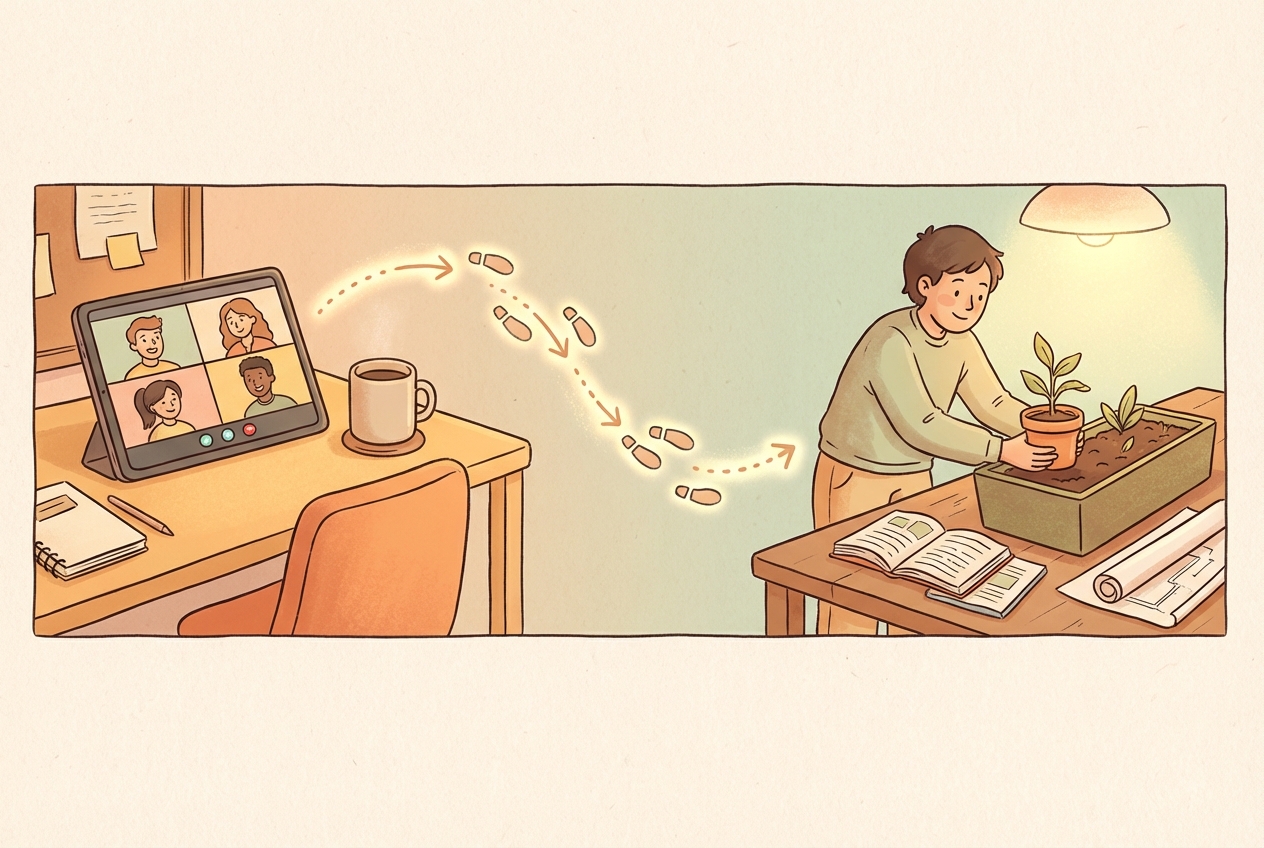

Every morning begins with a cascade of choices. What to eat. What to wear. Which emails demand immediate attention. Which tasks to tackle first. By noon, the mental reserves run low. By evening, even simple decisions feel overwhelming. This phenomenon has a name: decision fatigue. The psychological toll of constant choice-making depletes willpower and clouds judgment. Research from Columbia University suggests the average person makes approximately 35,000 decisions daily. Each one extracts a small cognitive tax. The cumulative effect leaves professionals exhausted, unfocused, and prone to poor judgment on the choices that actually matter. Getting clarity and a next step becomes increasingly difficult as mental resources deplete throughout the day. Cohera offers a systematic approach to this problem. Rather than fighting against cognitive limitations, the platform works with them. The result is a workflow architecture designed to preserve mental energy for high-stakes decisions while automating or simplifying routine ones.
The brain treats every decision as a resource expenditure. Small choices and significant ones draw from the same cognitive pool. This explains why executives often wear similar outfits daily. It explains why surgeons perform better in morning operations. Mental energy is finite. Spending it on trivial matters leaves less for critical thinking.
Cognitive load accumulates invisibly. The brain processes decisions through the prefrontal cortex, the same region responsible for complex reasoning and impulse control. Each choice activates this neural circuitry. Repeated activation leads to diminished function.
The workplace amplifies this effect through several mechanisms:
Constant context-switching between applications and tasks
Information scattered across multiple platforms
Unclear priorities competing for attention
Redundant approval processes requiring repeated evaluation
A single hour of knowledge work might involve dozens of micro-decisions. Which browser tab to check. Which notification to address. Which document version is current. These choices seem insignificant individually. Collectively, they erode the mental sharpness needed for strategic thinking.
Recognition precedes remedy. Choice overload manifests through specific behavioral patterns. Procrastination increases as the brain avoids additional cognitive strain. Quality of decisions deteriorates, particularly in afternoon hours. Irritability rises. Default options become increasingly attractive regardless of their actual merit.
Physical symptoms accompany the mental ones. Fatigue sets in earlier. Concentration lapses occur more frequently. The temptation to defer decisions grows stronger. These signals indicate a system under strain. Ignoring them leads to burnout. Addressing them requires structural changes to how information flows and decisions get made.
Cohera approaches decision fatigue as an architectural problem. The platform restructures information environments to minimize unnecessary choices. Every feature serves a specific purpose: preserving mental energy for decisions that genuinely require human judgment.
Information fragmentation forces repeated decisions about where to look. Documents live in one system. Communications exist in another. Project data resides somewhere else entirely. Each search represents a decision tree. Which platform first. Which folder. Which version.
Cohera eliminates this friction through unified information architecture:
Single-source access to all relevant documents and data
Intelligent indexing that surfaces contextually appropriate information
Version control that removes ambiguity about current status
Cross-platform integration that consolidates disparate sources
The cognitive savings compound over time. Fewer decisions about information retrieval means more capacity for information analysis. The brain stops wasting cycles on logistics and focuses on substance.
Friction represents hidden decision points. Every unnecessary click, every redundant confirmation, every ambiguous interface element demands cognitive processing. Cohera identifies and removes these friction sources systematically.
The platform analyzes workflow patterns to detect inefficiencies. Redundant steps get eliminated. Confusing interfaces get simplified. The goal is zero-friction pathways for routine operations. Users move from intention to action without intermediate decisions. This design philosophy preserves mental resources for situations where human judgment adds genuine value.
Clarity emerges from structure. Without frameworks for evaluation, every decision requires fresh analysis. With them, patterns become recognizable. Responses become more automatic. Cognitive load drops significantly.
Priority confusion generates constant micro-decisions. Which task demands immediate attention. Which can wait. Which requires collaboration. Which needs individual focus. Without clear signals, the brain cycles through these evaluations repeatedly.
Cohera implements intelligent filtering based on multiple criteria:
Deadline proximity and flexibility
Dependency relationships between tasks
Resource availability and constraints
Strategic importance relative to stated goals
Historical completion patterns
The system surfaces what matters most at any given moment. Users receive curated task lists rather than overwhelming backlogs. Decision fatigue decreases because the platform handles preliminary sorting. Human judgment focuses on execution rather than triage.
Certain decisions recur predictably. Approvals for standard requests. Routing of common document types. Scheduling of recurring meetings. These choices consume cognitive resources without requiring genuine deliberation.
Automation handles these patterns effectively. Cohera learns from historical decisions to identify automation candidates. Rules get established for predictable scenarios. The system executes routine choices according to defined parameters. Human oversight remains available for exceptions. Standard cases proceed without manual intervention.
The impact extends beyond time savings. Each automated decision represents preserved mental energy. That energy remains available for complex problems where automation falls short. The human brain handles nuance and novelty. The system handles repetition and routine.
Sustainable productivity requires more than immediate efficiency gains. Long-term focus depends on environmental design that supports deep work. Cohera addresses both immediate and extended cognitive demands.
Attention fragmentation represents a particular form of decision fatigue. Each notification demands evaluation. Each context switch requires reorientation. The cumulative effect destroys the concentration needed for complex work.
Unified views consolidate information streams into coherent displays. Rather than monitoring multiple channels, users observe single dashboards. Rather than switching between applications, they navigate within integrated environments. The platform provides:
Consolidated notification management with intelligent batching
Context-preserving transitions between related tasks
Customizable views that match individual work patterns
Scheduled focus periods with distraction suppression
These features create conditions for sustained attention. The brain stops allocating resources to monitoring and switching. Those resources flow instead toward the work itself. Deep focus becomes achievable rather than aspirational.
The ultimate purpose of reducing decision fatigue is preserving capacity for consequential choices. Strategic decisions deserve full cognitive engagement. Creative problems require fresh mental energy. Complex negotiations demand sharp judgment. These situations suffer when mental resources have been depleted by trivia.
Cohera creates this preservation systematically. By handling routine decisions automatically, the platform banks cognitive capacity. By centralizing information access, it eliminates search-related fatigue. By providing clear prioritization, it removes evaluation overhead. The cumulative effect is significant. Users arrive at important decisions with mental resources intact.
The platform also supports high-stakes decision-making directly through several mechanisms:
Decision documentation that captures reasoning for future reference
Scenario modeling that clarifies potential outcomes
Stakeholder input collection that ensures comprehensive perspective
Progress tracking that maintains momentum through implementation
Getting clarity and taking the next step with Cohera becomes a reliable process rather than a struggle against mental exhaustion.
The path forward is clear. Decision fatigue represents a solvable problem. The solution lies not in willpower or discipline but in environmental design. Cohera provides that design. The platform restructures information environments to minimize cognitive waste. It automates routine choices. It surfaces priorities. It eliminates friction.
The result is a workflow that respects human cognitive limitations while maximizing human cognitive potential. Mental energy flows toward decisions that matter. Routine operations handle themselves. Clarity replaces confusion. Confidence replaces hesitation.
Those experiencing the symptoms of choice overload have an alternative. That alternative is architectural rather than aspirational. Cohera transforms how decisions get made by transforming the environment in which they occur. The technology exists. The methodology is proven. The next step is implementation.