A teenager in rural Montana texts "I can't stop crying" at 2 AM. Within seconds, a response arrives: "That sounds really overwhelming. Can you tell me more about what's happening?" The reply comes not from a human therapist - there's none available at that hour within 200 miles - but from an AI chatbot trained to provide mental health support.
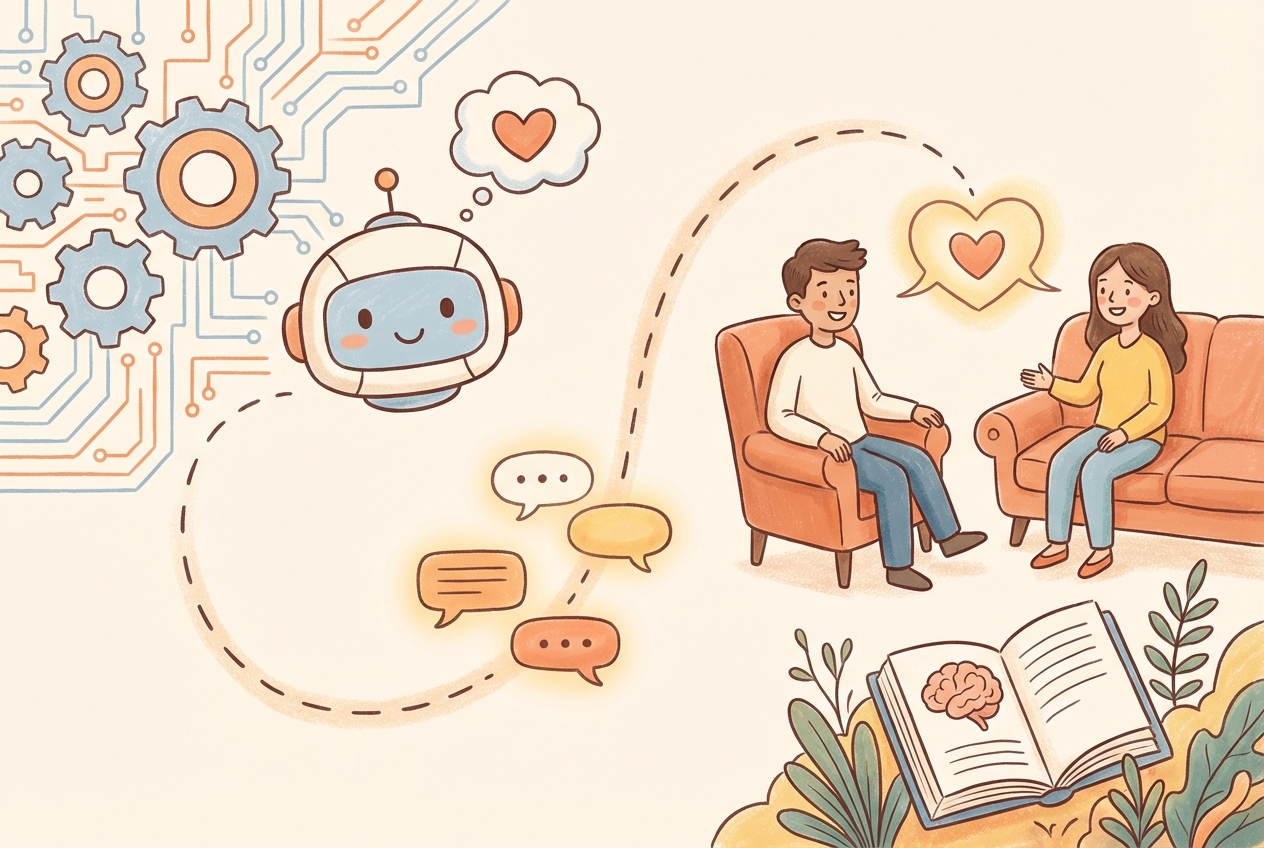
This scenario plays out millions of times daily across the globe. Understanding how AI chat therapy works, from algorithms to empathy, reveals a fascinating intersection of computer science and psychology. These digital tools aren't replacing human connection. They're filling gaps where human support simply doesn't exist. The technology behind these interactions has evolved dramatically, moving from simple scripted responses to sophisticated systems that can detect emotional nuance, adapt their communication style, and even recognize crisis situations requiring human intervention.
What makes these conversations feel genuinely supportive? How do machines simulate something as fundamentally human as empathy? The answers lie in decades of technological evolution and careful psychological research.
The journey began in 1966 with ELIZA, a program created by MIT's Joseph Weizenbaum. ELIZA used simple pattern matching to mimic a Rogerian therapist. If you typed "I feel sad," it might respond "Why do you feel sad?" The system had no understanding - just rules.
Modern AI therapy tools operate on entirely different principles. Large language models like GPT-4 process text through billions of parameters, recognizing context, tone, and implicit meaning. They don't just match patterns. They generate novel responses based on statistical relationships learned from vast training data.
ELIZA operated with roughly 200 scripted rules
Current models contain hundreds of billions of parameters
Response generation now considers thousands of contextual factors
Training data includes millions of therapeutic conversation examples
Early chatbots were curiosities. Modern AI therapy tools undergo rigorous clinical validation. Apps like Woebot and Wysa have published peer-reviewed studies demonstrating measurable reductions in depression and anxiety symptoms among users.
This shift reflects broader acceptance within the mental health community. The American Psychological Association now recognizes digital interventions as legitimate treatment modalities. Insurance companies increasingly cover AI-assisted therapy. Regulatory bodies have established frameworks for evaluating these tools' safety and efficacy.
Natural language processing forms the foundation of AI therapy. These systems break down your messages into components: individual words, phrases, sentence structures, and semantic meaning. Sentiment analysis then evaluates the emotional content.
The technology goes beyond simple positive/negative classification. Modern systems detect:
Specific emotions like anger, fear, hopelessness, or frustration
Intensity levels ranging from mild concern to acute distress
Linguistic markers associated with various mental health conditions
Changes in emotional state across conversation history
When you type "I guess everything's fine," the AI recognizes the disconnect between the positive words and the hedging language suggesting otherwise.
Each conversation teaches the system about your communication preferences. Some users respond well to direct advice. Others need more space to process their thoughts. Machine learning models track these patterns and adjust accordingly.
Personalization happens across multiple dimensions. The system learns your vocabulary preferences, optimal response length, and which therapeutic techniques resonate with you. Over time, your AI therapist becomes increasingly calibrated to your specific needs.
Human therapists demonstrate empathy through active listening: reflecting back what clients say, asking clarifying questions, and validating emotional experiences. AI systems replicate these patterns through carefully designed response frameworks.
When you share a difficult experience, the AI might respond with:
Reflection: "It sounds like you're feeling overwhelmed by work pressure"
Validation: "Those feelings make complete sense given what you're dealing with"
Clarification: "Help me understand - is the stress more about deadlines or relationships with colleagues?"
Encouragement: "Thank you for sharing that with me"
These responses aren't random. They're generated based on therapeutic communication research showing which patterns most effectively convey understanding.
Most AI therapy tools incorporate CBT principles. This evidence-based approach focuses on identifying and restructuring unhelpful thought patterns. The structured nature of CBT translates well to algorithmic implementation.
A typical AI-guided CBT interaction might help you identify a cognitive distortion, examine evidence for and against the thought, and develop a more balanced perspective. The system tracks your progress through these exercises, noting which techniques prove most effective for your specific challenges.
CBT's emphasis on homework and skill-building also suits digital delivery. Your AI therapist can send reminders, track mood patterns, and celebrate progress - all without requiring scheduled appointments.
Your therapy conversations contain deeply personal information. Reputable AI therapy platforms implement multiple security layers to protect this data.
End-to-end encryption ensures messages remain unreadable during transmission. Data at rest receives additional encryption. Access controls limit who can view conversation logs. Regular security audits identify vulnerabilities before bad actors can exploit them.
HIPAA compliance requires:
Business associate agreements with all data processors
Documented security policies and procedures
Employee training on privacy requirements
Breach notification protocols
Regular risk assessments
Not all AI therapy apps meet these standards. Users should verify compliance before sharing sensitive information.
AI therapy tools must recognize when users need immediate human intervention. Natural language models are trained to detect crisis indicators: explicit statements of self-harm intent, sudden mood changes, or language patterns associated with acute psychiatric emergencies.
When the system detects potential crisis, automated protocols activate. These might include providing crisis hotline numbers, alerting designated emergency contacts, or connecting users directly with human crisis counselors. The AI clearly communicates its limitations - it can provide support, but it can't replace emergency services.
This boundary represents a crucial ethical line. AI therapy works best as one component of a broader mental health ecosystem, not as a standalone replacement for human care.
The mental health care gap is staggering. The World Health Organization estimates that 75% of people with mental health conditions in low-income countries receive no treatment. Even in wealthy nations, rural areas, marginalized communities, and people with limited financial resources face significant barriers to care.
AI therapy tools offer unprecedented scalability. A single platform can serve millions of users simultaneously, in multiple languages, at any hour. The marginal cost of each additional user approaches zero. This economic reality makes mental health support accessible to populations that traditional care models simply cannot reach.
Translation capabilities continue improving. Cultural adaptation ensures therapeutic approaches respect local norms and values. Voice interfaces expand access to users with limited literacy.
The most promising future isn't AI replacing therapists - it's AI augmenting their capabilities. Imagine a system that analyzes session transcripts to identify patterns the clinician might miss. Or one that tracks client progress between appointments, flagging concerning changes for immediate attention.
AI tools can handle administrative burdens that consume therapists' time: scheduling, documentation, insurance coding. This frees clinicians to focus on the deeply human work that machines cannot replicate.
Some platforms already offer hybrid models. Users interact with AI between sessions, then review insights with their human therapist during appointments. The AI handles skill-building exercises and mood tracking. The human provides the nuanced understanding and genuine connection that defines effective therapy.
The technology powering AI chat therapy has matured remarkably. These systems now detect emotional nuance, adapt to individual needs, and recognize their own limitations. They're not perfect - no therapeutic tool is - but they're filling critical gaps in mental health care.
If you're considering AI therapy, approach it as one tool among many. It works well for building coping skills, tracking mood patterns, and accessing support between human therapy sessions. It's less suited for complex trauma, severe mental illness, or situations requiring human judgment.
The algorithms have learned to simulate empathy. Whether that simulation provides genuine healing depends on you, your needs, and how you integrate these tools into your broader mental health journey. The technology exists to help. The choice to use it wisely remains yours.