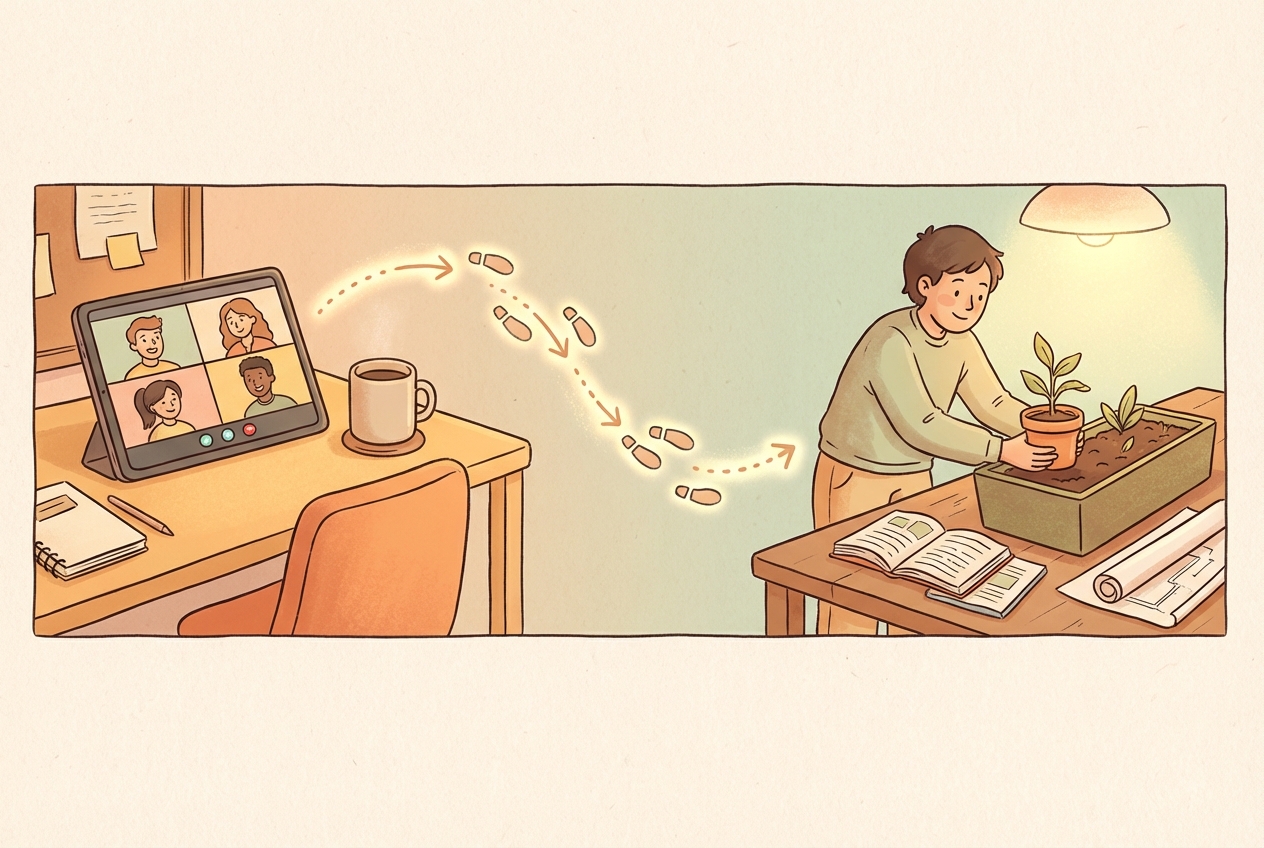
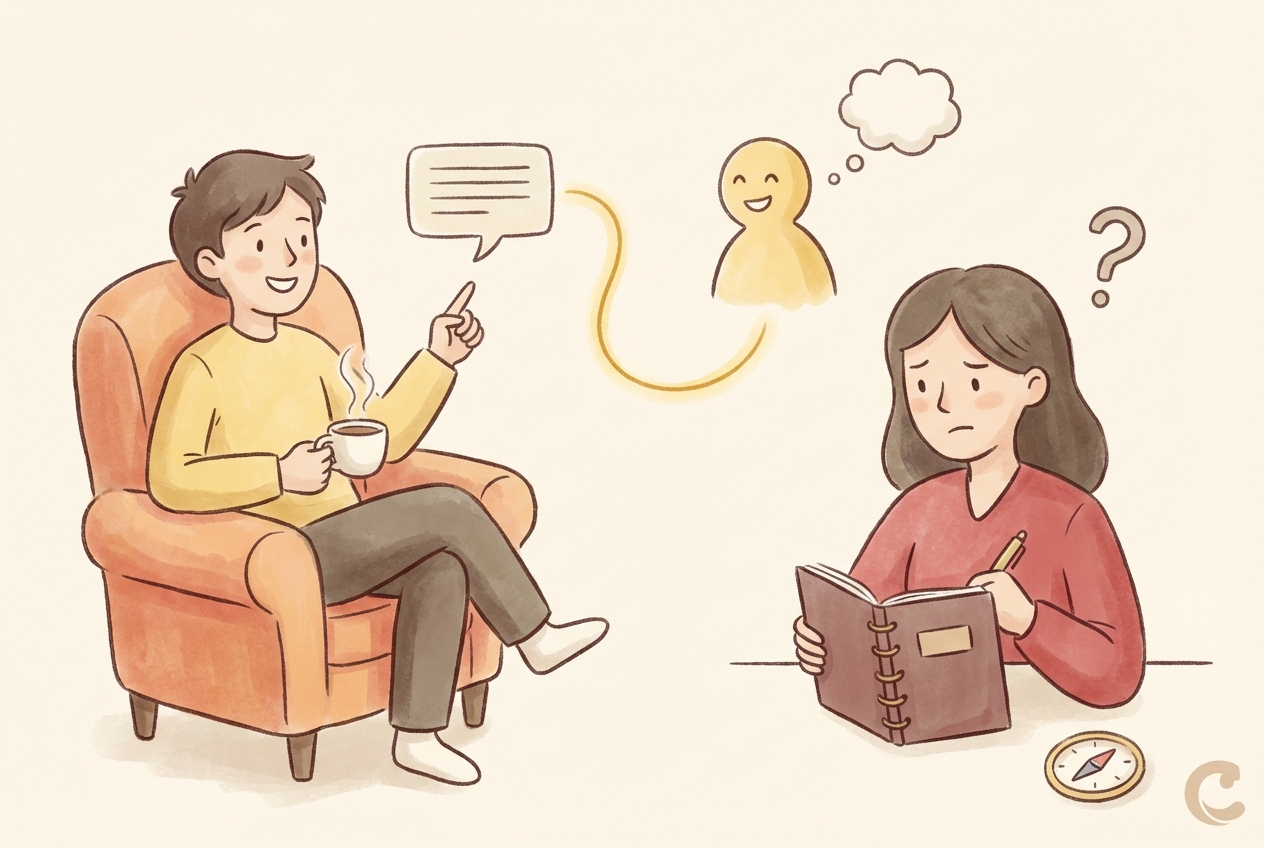
You've downloaded another journaling app. The interface looks clean, the prompts seem thoughtful, and you're convinced this time will be different. Three weeks later, it sits unopened on your phone, another digital ghost collecting dust. This pattern repeats for millions of people seeking mental wellness tools. The problem isn't willpower or commitment. The problem is the fundamental approach. Traditional journaling apps ask you to generate insights from a blank page, assuming you already know what to explore. Cohera takes a radically different path. Instead of leaving you alone with your thoughts, it engages you in guided conversations that actively help you discover what you're feeling and why. This shift from passive reflection to active dialogue represents something significant for digital wellness. When you move beyond journaling apps toward Cohera's guided conversations, you're not just changing tools. You're changing how you relate to your own mind.
The journey from pen-and-paper diaries to smartphone apps seemed like progress. We could journal anywhere, anytime, with prompts at our fingertips. Yet something crucial got lost in translation. Digital journaling inherited the same fundamental limitation as its analog predecessor: it relies entirely on your ability to know what needs examining.
Staring at an empty text field triggers a specific kind of paralysis. Your mind goes blank precisely when you need it most. Traditional journaling apps compound this problem by offering generic prompts that don't respond to your actual state.
"What are you grateful for today?" feels hollow when you're anxious about a work presentation
"Describe your mood" assumes you can accurately identify complex emotions
"Write about your goals" doesn't help when you're struggling with direction
Static prompts can't adapt to whether you need support, challenge, or validation
The blank page syndrome isn't laziness. It's a design flaw. You're asked to be both patient and therapist simultaneously, generating questions and answers without guidance.
Cohera's approach flips this dynamic entirely. Instead of presenting an empty canvas, it initiates conversation. You respond to specific, contextual questions that build on each other. The system notices patterns you might miss and gently directs attention toward productive territory.
This mirrors how effective therapy works. A skilled counselor doesn't hand you a blank notebook. They ask questions, listen carefully, and follow threads that seem meaningful. Cohera brings this interactive quality to daily mental wellness practice.
Your brain processes information differently when engaged in dialogue versus monologue. Conversation activates different neural pathways, promoting deeper processing and better retention. Cohera's framework capitalizes on these cognitive realities.
Stream-of-consciousness writing has its place. But for consistent mental health maintenance, structure provides crucial scaffolding. Cohera's prompts create what psychologists call "retrieval cues," helping you access thoughts and memories that might otherwise remain buried.
Structured prompts reduce the cognitive load of deciding what to write about
Sequential questions build logical pathways through complex emotional territory
Specific inquiries surface concrete details rather than vague generalizations
The conversational format keeps you engaged rather than drifting
Unstructured journaling often produces circular thinking. You write the same worries repeatedly without resolution. Guided conversations break these loops by introducing new angles and perspectives.
Every choice depletes a finite daily reserve of mental energy. Traditional journaling apps front-load decisions: What should I write about? How deep should I go? What's the right format? These micro-decisions accumulate into resistance.
Cohera eliminates this friction. You simply respond to what's asked. The cognitive burden shifts from "what should I explore" to "what do I actually think about this." This reduction in decision fatigue makes consistent practice far more sustainable. You're not wrestling with the tool before you can use it.
Static journaling provides no feedback loop. You write, save, and move on. Whether your reflection was productive or merely rumination remains unclear. Cohera's interactive nature changes this fundamentally.
When Cohera responds to your input, it creates moments of recognition. You see your words reflected back, sometimes reframed in ways that reveal what you actually meant. This mirroring function helps identify emotional patterns that stay invisible in traditional journaling.
The system might notice you mention work stress every Monday evening. It might observe that conversations about family trigger defensive language. These patterns emerge naturally through dialogue in ways they rarely do through solo writing.
Recurring themes become visible across multiple conversations
Emotional intensity gets tracked and contextualized over time
Contradictions between stated feelings and underlying concerns surface naturally
Progress becomes measurable rather than assumed
Most people exist in a middle space. They don't need intensive therapy but want more than generic self-help advice. Cohera occupies this territory effectively. It provides personalized guidance without the cost, scheduling challenges, or stigma some associate with professional help.
This isn't a replacement for therapy when therapy is needed. But for daily emotional maintenance and growth, guided conversations offer something traditional apps simply can't match. You get responsive support that meets you where you are, not where a generic prompt assumes you might be.
Generic advice helps no one. What works for managing your friend's anxiety might worsen yours. Cohera's adaptive system learns your specific patterns, triggers, and effective coping strategies over time.
The platform remembers your history. It knows that deep breathing exercises work for your pre-meeting nerves but not for your late-night spiraling. It recalls that you process grief through physical activity and anger through verbal expression.
This personalization compounds in value. Early conversations establish baselines. Subsequent interactions refine understanding. Eventually, Cohera's prompts feel less like generic questions and more like inquiries from someone who genuinely knows you.
Morning check-ins adapt based on your sleep patterns and upcoming schedule
Stress responses get customized to your proven coping mechanisms
Conversation depth adjusts to your current emotional capacity
Challenging prompts appear when you're ready, supportive ones when you need them
The best mental wellness tool is the one you actually use. Consistency matters more than intensity. Cohera's design addresses the habit formation challenges that doom most journaling attempts.
Static apps grow stale. You've seen the prompts before. The novelty wears off. Without novelty, engagement drops. Without engagement, the app joins the digital graveyard.
Dynamic conversation resists this decay. Each interaction differs based on your responses, current state, and accumulated history. You can't predict exactly what Cohera will ask because it genuinely responds to you.
Unpredictability maintains curiosity and engagement
Personalized content feels relevant rather than recycled
Progress visualization shows concrete growth over time
The conversational format feels less like homework and more like connection
This engagement translates directly into habit formation. When something feels valuable and slightly surprising each time, you return to it naturally. The guided conversations become part of your routine because they earn that place.
We're witnessing a fundamental shift in how technology supports mental health. The passive, one-size-fits-all approach of traditional journaling apps served as a necessary stepping stone. But Cohera's guided conversations represent where digital wellness is heading.
The reasons are clear. People need responsive tools, not static ones. They need personalization, not generic advice. They need dialogue, not monologue. As AI capabilities expand, the gap between traditional apps and conversational platforms will only widen.
Your mental wellness practice deserves better than a blank page and good intentions. Cohera offers something genuinely different: a thinking partner that learns, adapts, and grows alongside you. The question isn't whether guided conversations are more effective than traditional journaling apps. The evidence already answers that. The question is whether you're ready to experience the difference yourself.
Try Cohera and discover what your mental wellness practice has been missing. The conversation is waiting.